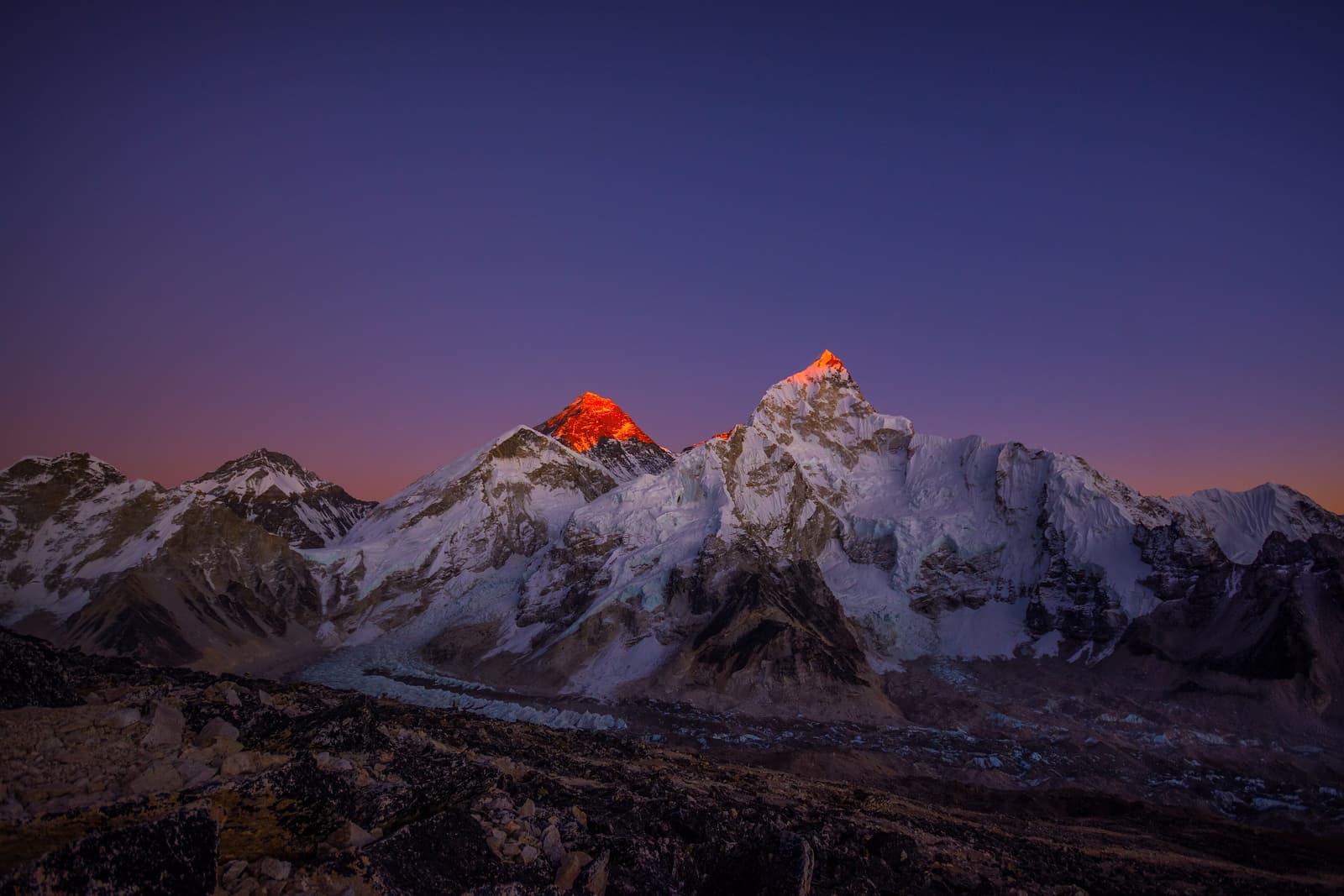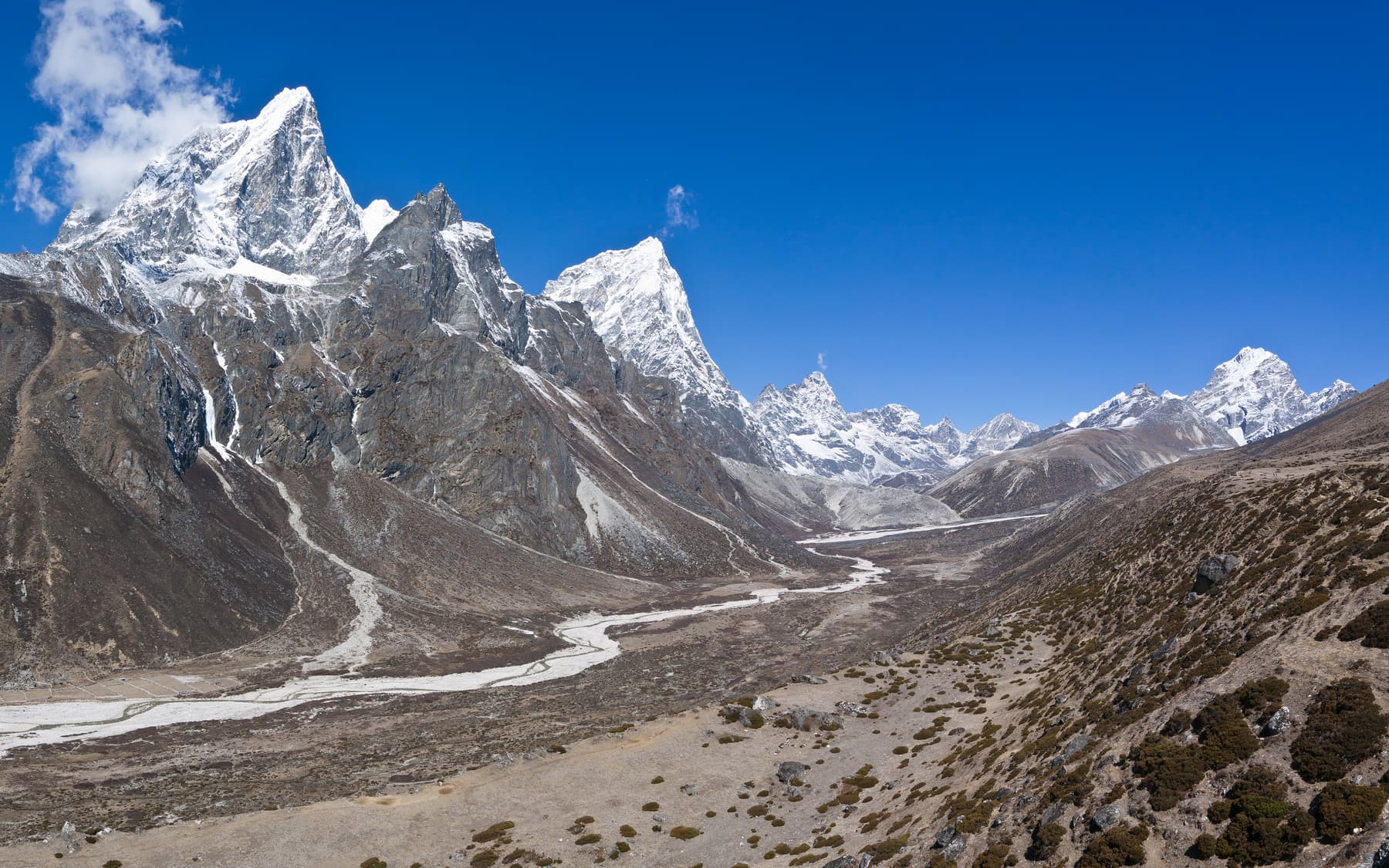
Sagarmatha National Park covers the upper catchment of the Dudh Koshi and Bhote Koshi rivers in Nepal’s Solukhumbu District — the region known as the Khumbu. It is small by Himalayan standards, 1,148 km², but it rises from about 2,845 m at Monjo to 8,848.86 m on the summit of Everest, the greatest vertical range of any protected area on Earth.
The park at a glance
- Established: 19 July 1976, the first national park in Nepal’s Himalaya.
- World Heritage: inscribed by UNESCO in 1979 for its exceptional natural beauty.
- Area: 1,148 km², plus a 275 km² buffer zone added in 2002 that takes in the trail from Lukla to Monjo.
- Headquarters: on the hill above Namche Bazaar, with a visitor centre.
- Entrance: the gate at Monjo/Jorsalle on the trail from Lukla.
- Landscape: roughly two-thirds is rock, snow and ice above 5,000 m; most of the rest is alpine pasture, and only a small share is forest.
- People: several thousand Sherpas live in villages inside the park, which remain legally outside its boundary as enclaves.
A short history
Until 1950 Nepal was closed to foreigners, and Everest was attempted only from Tibet. After the first ascent by Tenzing Norgay and Edmund Hillary on 29 May 1953, expeditions and then trekkers began to arrive, and by the early 1970s the demand for firewood and timber was visibly thinning the Khumbu’s slow-growing forests. Hillary, among others, pressed for protection; New Zealand advisers helped Nepal set up the park and train its first wardens, several of them Sherpas.
The park’s early years were not easy — a ban on cutting green wood overturned traditional village forest management — but the approach has since shifted towards working with local people. A share of park revenue is returned to buffer-zone communities, and village user groups help manage forests, trails and waste.
Permits and fees
Foreign visitors currently need two documents. Neither is the TIMS card used elsewhere in Nepal, which has not been required in the Khumbu since the local fee was introduced.
| Permit | Approximate cost | Where to get it |
|---|---|---|
| Sagarmatha National Park entry permit | Around NPR 3,000 per person for most foreigners; lower for SAARC nationals; children under 10 free | Park entry post at Monjo, or the Nepal Tourism Board office in Kathmandu |
| Khumbu Pasang Lhamu Rural Municipality fee | Around NPR 2,000–3,000 per person (the rate has been revised — check locally) | Municipality counter in Lukla; also checked at Monjo |
| Climbing permit (only for peaks such as Island Peak) | Varies by peak and season | Arranged through a registered agency |
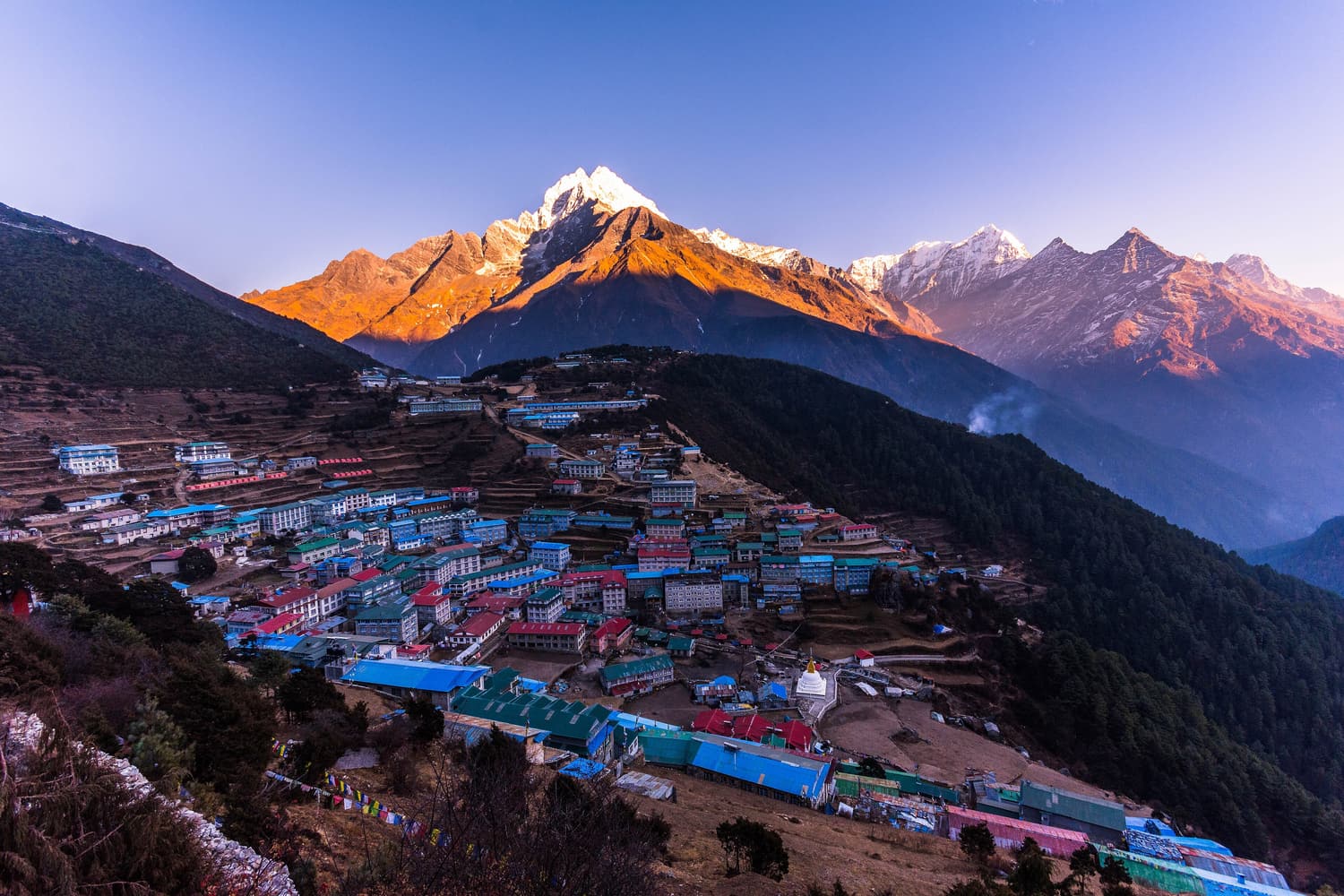 Gateways to the park 3,440 m
 Namche Bazaar
The Sherpa capital and park headquarters
A horseshoe of lodges, bakeries and shops in a natural amphitheatre at 3,440 m. Namche is the trading hub of the Khumbu, home to the Saturday market, the Sherpa museum and the national park visitor centre — and the place where every visitor pauses to acclimatise.
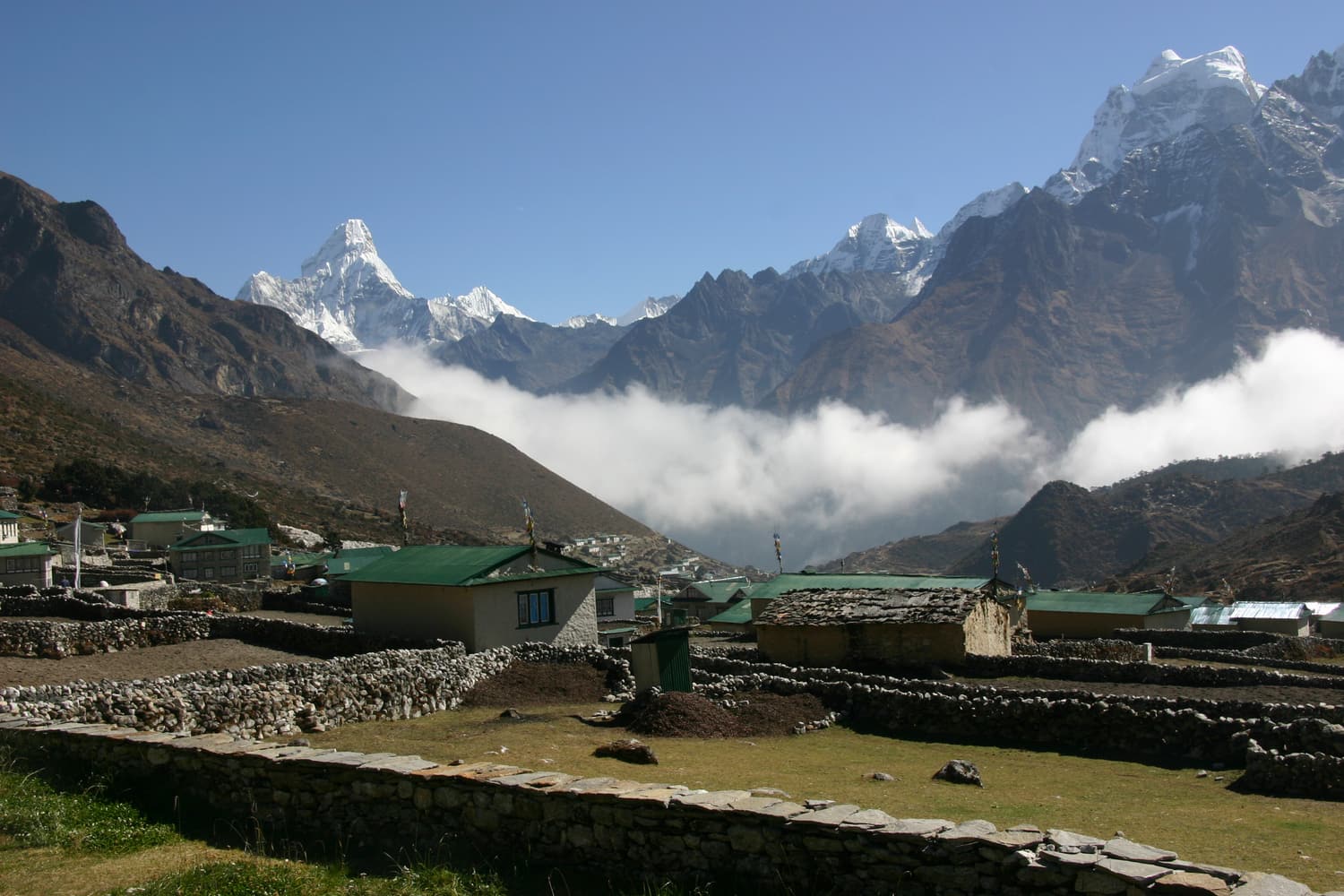 Sherpa villages & monasteries 3,790 m
 Khumjung & Khunde
Green-roofed twin villages beneath sacred Khumbila
Two traditional Sherpa villages in a broad valley above Namche at about 3,790 m, with stone-walled potato fields, the school Sir Edmund Hillary founded in 1961, the Khunde hospital and a monastery that keeps a famous “yeti scalp”.
 Sherpa villages & monasteries 3,867 m
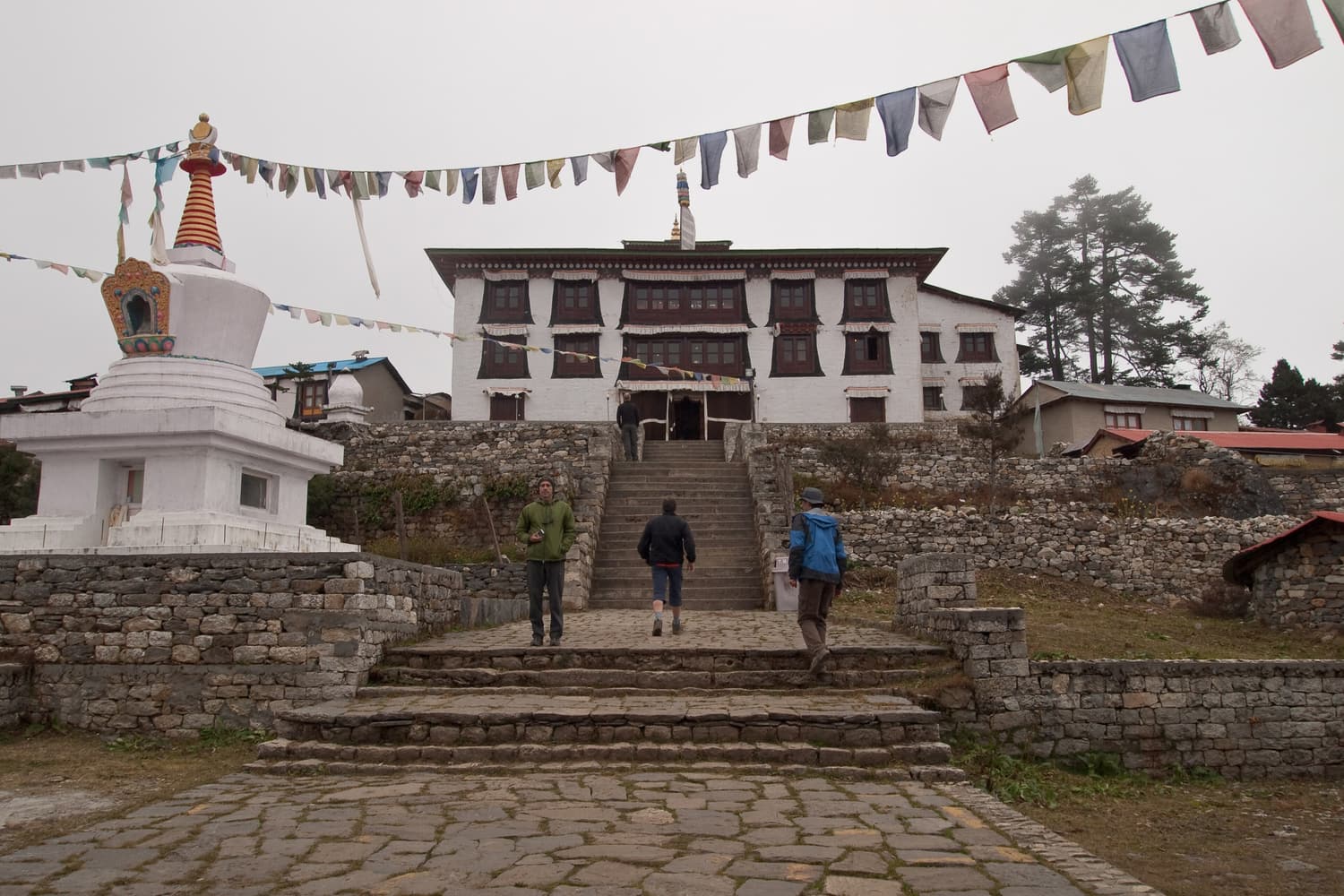
 Tengboche Monastery
The spiritual heart of the Khumbu
The largest monastery in the Khumbu stands on a forested saddle at 3,867 m with Ama Dablam, Everest and Lhotse on the horizon. Visitors may attend prayers, and each autumn the masked dances of the Mani Rimdu festival fill its courtyard.
 Sherpa villages & monasteries 3,985 m
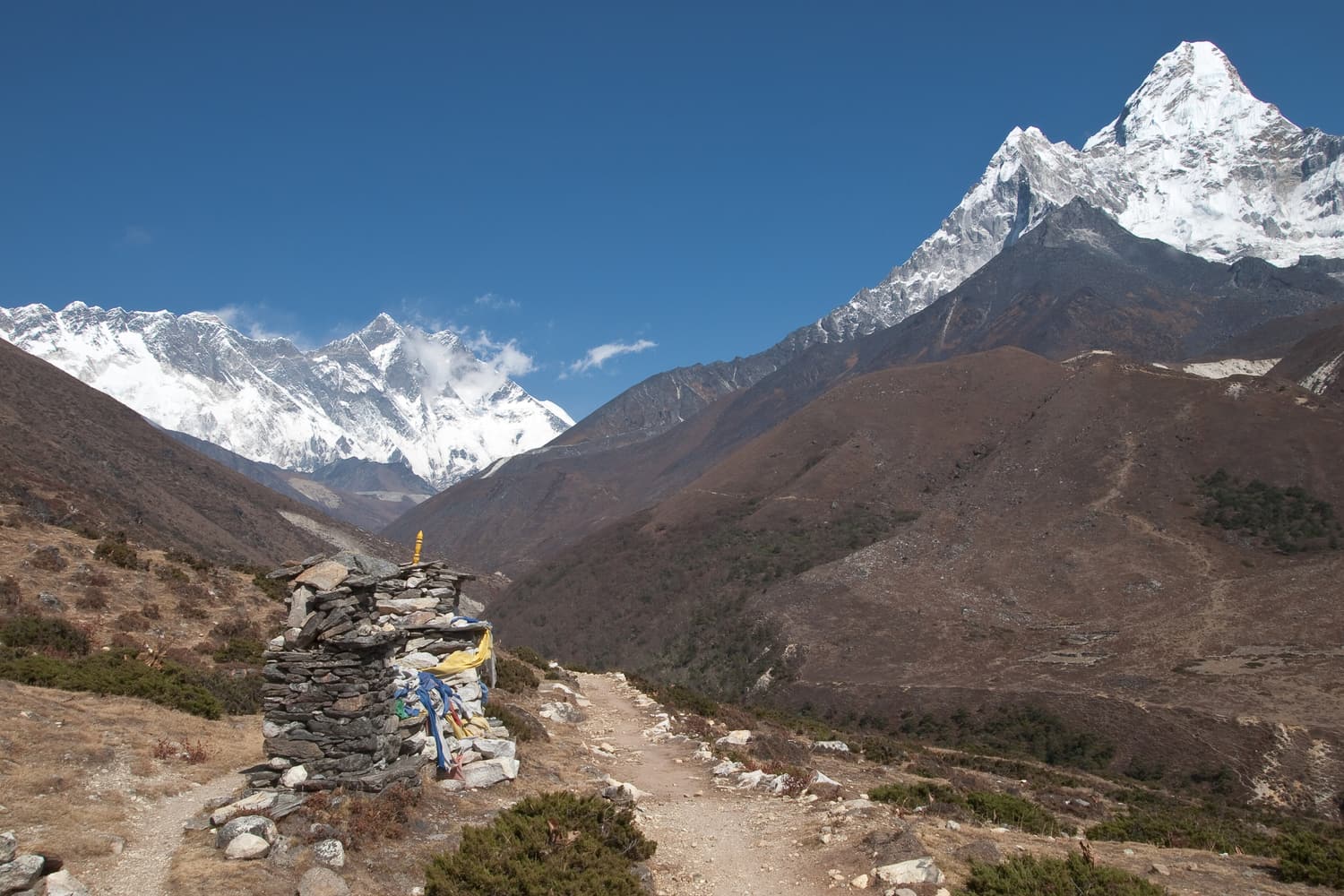
 Pangboche & Ama Dablam Base Camp
The oldest gompa and the loveliest mountain
Pangboche (about 3,985 m) is a year-round farming village with what is considered the oldest monastery in the Khumbu. Across the river a side trail climbs to the grassy base camp of Ama Dablam at about 4,600 m — one of the best day walks in the park.
Bring your passport and enough cash in Nepali rupees; cards are not accepted at the counters. Fees are set by the authorities and change from time to time, so treat the figures above as a guide. If you book a package, permits are normally arranged for you — check the inclusions.
Do you need a guide?
In 2023 the Nepal Tourism Board announced that foreign trekkers must hire a licensed guide in national parks and conservation areas. The Khumbu Pasang Lhamu Rural Municipality stated at the time that it would not apply the requirement in its area, and independent trekkers have continued to be admitted with the local permit. The position is not settled, and could change in either direction.
Our advice: on the main trail to Namche and Tengboche in good weather, an experienced walker can manage alone; for the Gokyo valley, the Three Passes or any winter visit, a licensed guide is a real safety margin and a source of local knowledge. Hiring a guide and a porter also puts money directly into the local economy. Confirm the current rule with your agency or the Nepal Tourism Board shortly before you travel.
Altitude
Altitude is the main risk in the park, and it does not respect fitness or age. Acute mountain sickness (AMS) — headache with nausea, dizziness, fatigue or poor sleep — is common above 3,000 m. It is a warning: if you keep climbing with symptoms, it can progress to life-threatening fluid on the brain (HACE) or lungs (HAPE).
- Go slowly. Above 3,000 m, raise your sleeping altitude by no more than about 300–500 m a day, and take a rest day for every 1,000 m gained.
- Climb high, sleep low. Day walks above your lodge, such as Namche to the Everest View ridge, help you adapt.
- Never go higher with symptoms. If they worsen at rest, descend — even at night.
- Drink plenty, avoid alcohol and sleeping pills on the way up.
- Ask a doctor about acetazolamide (Diamox) before you leave home.
- Insure yourself for trekking to the altitude of your route, including helicopter evacuation.
Seasonal aid posts staffed by volunteer doctors have operated at Pheriche (Himalayan Rescue Association) and Machhermo, with free daily talks on altitude; the hospital at Khunde serves the Namche area.
What a visit costs
Costs vary widely with comfort and season, so take these as orders of magnitude rather than quotes.
- Getting in: the return flight to Lukla is the largest single cost for most independent visitors, typically a few hundred US dollars.
- Food and lodging: often US$30–50 a day in tea houses, rising with altitude and comfort.
- Guide and porter: daily rates are agreed in advance and should include their food, lodging, insurance and equipment; tips at the end are customary.
- Extras: hot showers, charging, Wi-Fi, bottled drinks and bakery stops add up quickly above Namche.
- Packages: guided treks on GetYourGuide currently start from a few hundred euros for land-only arrangements and run to about €1,000–1,800 with flights; see treks and tours.
Park rules
- Carry your permits and show them at checkpoints.
- Do not disturb, feed or hunt wildlife, and do not pick plants or collect rocks, fossils or other natural objects.
- Do not buy products made from wild animals or protected plants.
- Fires and the cutting of wood are prohibited; lodges are expected to cook with gas, kerosene or electricity.
- Camp only at designated sites.
- Carry out what you carry in; use bins and lodge toilets.
- Flying a drone requires permission from several authorities — do not launch one without it.
- Respect religious sites: see Sherpa culture and etiquette.
Responsible trekking
Tens of thousands of visitors a year walk through a high, cold, slow-to-recover landscape. How they behave matters.
Waste
The Sagarmatha Pollution Control Committee (SPCC), a local organisation founded in 1991 and based in Namche, manages waste in the Khumbu: it maintains bins and collection points along the trails, runs clean-ups and oversees waste from Everest Base Camp, where expeditions pay a refundable deposit against bringing their rubbish down. A voluntary “Carry Me Back” scheme invites trekkers to take a small bag of sorted waste from the upper park to Lukla for recycling.
- Refill a bottle with boiled, filtered or treated water instead of buying plastic bottles. The municipality has banned thin single-use plastics and restricted plastic drink bottles since 2020.
- Take batteries, wrappers and toiletries back to Kathmandu.
- Choose lodges with proper toilets and do not leave paper on the trail.
Porters and guides
- Hire through an agency that insures its staff and provides proper clothing, footwear and shelter for the altitude.
- Keep loads reasonable — trekking porters’ loads are commonly limited to around 25–30 kg, including their own kit.
- If a porter falls ill, he must be accompanied down, never sent alone.
- Tip fairly, and directly.
Energy and wildlife
- Hot showers and stove fuel are precious. Prefer solar-heated water, and dress warmly rather than asking for the stove to be lit early.
- Keep to the trails; alpine turf and juniper take decades to recover.
- Give animals space and yaks the right of way — stand on the uphill side of the trail as a caravan passes.
Practicalities
- Money: Nepali rupees in cash. ATMs exist in Lukla and Namche but often fail.
- Phones and internet: mobile coverage reaches much of the main valley; lodges sell Wi-Fi by card or by the hour.
- Electricity: small hydro plants power the lower villages; higher up it is solar, and charging is paid for.
- Water: treat all water. Boiled water is sold by lodges.
- Health: Khunde hospital, health posts in Namche and Lukla, seasonal aid posts higher up; helicopter evacuation needs insurance or payment guaranteed in advance.
- Packing: layers for +15 °C to −15 °C, a down jacket, a warm sleeping bag, broken-in boots, sun protection, water treatment, a head torch and a basic first-aid kit.