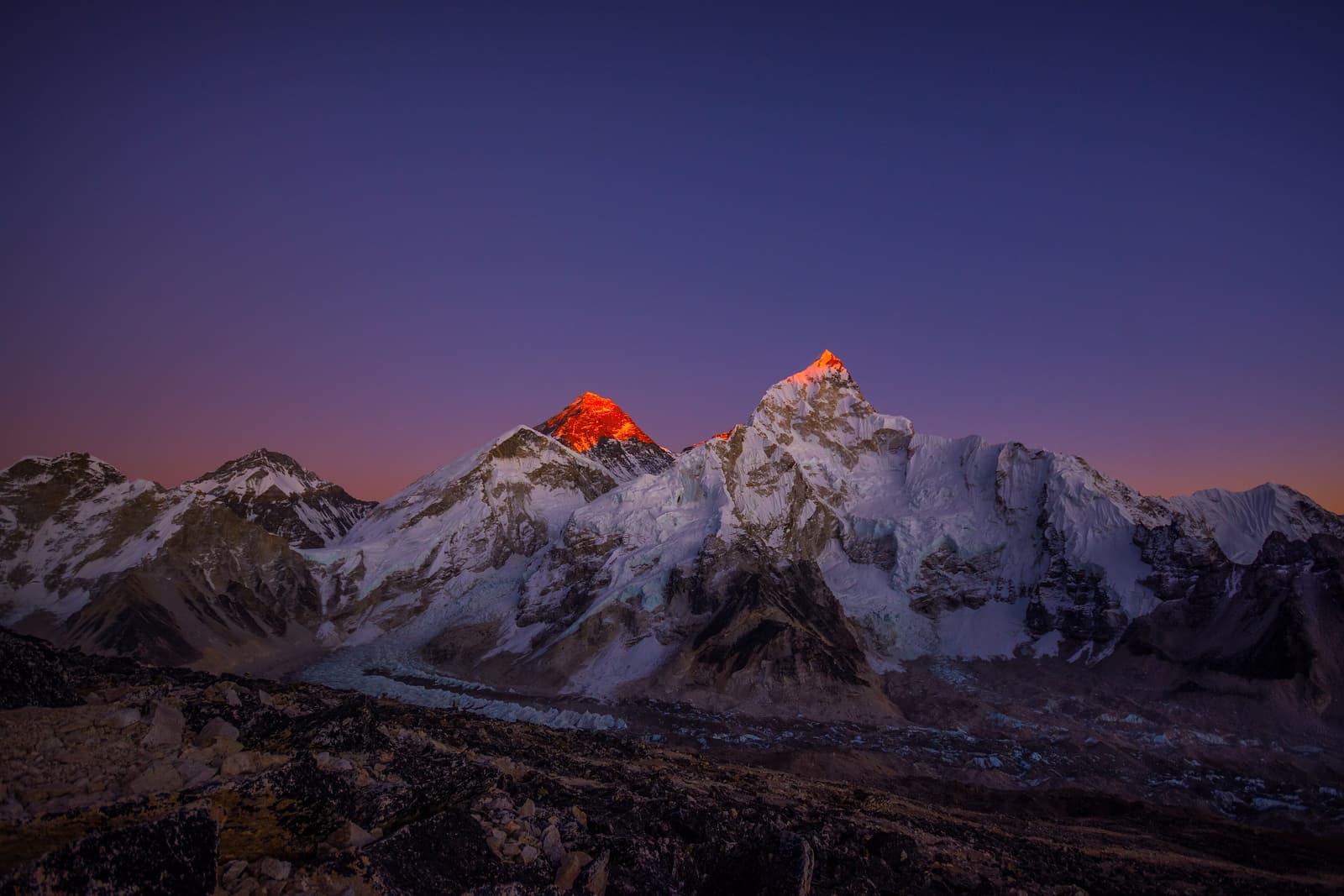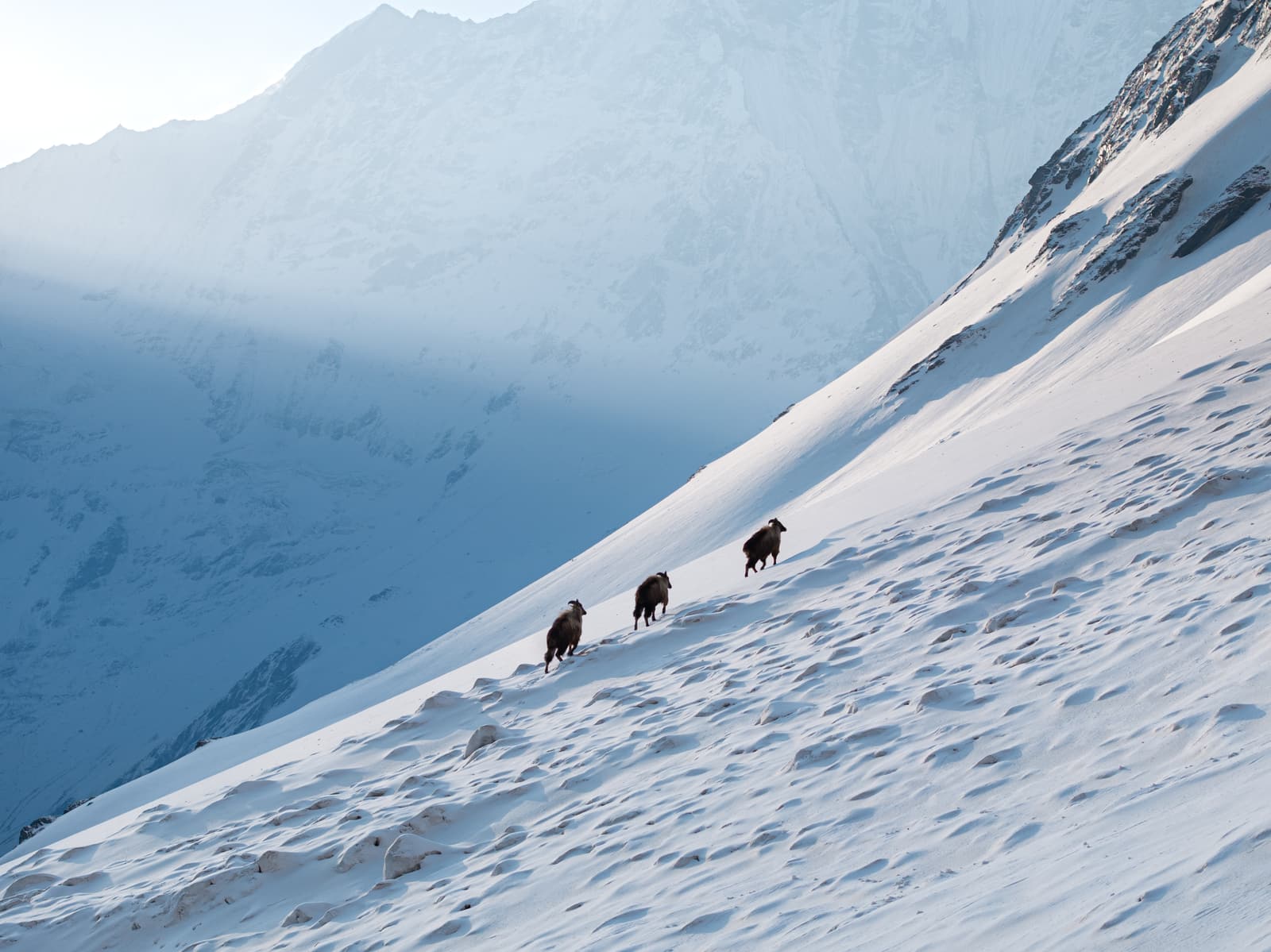
UNESCO listed Sagarmatha for its “exceptional natural beauty”: dramatic mountains, glaciers and deep valleys dominated by the highest peak on Earth. But the park is also a compressed lesson in mountain ecology. In a day’s walk from Monjo to Namche you climb out of pine and hemlock forest; two days later you are among dwarf juniper; a day after that there is only rock, ice and lichen.
The great peaks
The park’s northern boundary is the main Himalayan crest, which is also the border with Tibet. Three of the world’s fourteen 8,000-metre mountains stand on it, and a fourth, Makalu, is in view just to the east.
| Peak | Height | Where to see it | Good to know |
|---|---|---|---|
| Everest (Sagarmatha / Chomolungma) | 8,848.86 m | Kala Patthar, Gokyo Ri, Renjo La, Everest View ridge, Tengboche | The highest mountain on Earth; first climbed on 29 May 1953 |
| Lhotse | 8,516 m | Chhukung, Dingboche, Everest View ridge | Fourth highest; its south face is one of the greatest walls in the Himalaya |
| Cho Oyu | 8,188 m | Gokyo Ri and the fifth lake | Sixth highest; stands at the head of the Gokyo valley |
| Nuptse | 7,861 m | Kala Patthar, Lobuche | The long wall that hides Everest from much of the Khumbu |
| Pumori | 7,161 m | Gorak Shep, Kala Patthar | The graceful pyramid above Kala Patthar |
| Ama Dablam | 6,812 m | Tengboche, Pangboche, Dingboche | “Mother’s necklace” — the park’s most recognisable mountain |
| Thamserku | 6,608 m | Namche Bazaar, Monjo | Towers directly above Namche |
| Khumbila | 5,761 m | Khumjung, Khunde | Home of the Khumbu’s protector deity; climbing is not permitted |
Heights are those in general use; surveys differ by a few metres. Everest’s official height of 8,848.86 m was announced jointly by Nepal and China in 2020. Other peaks that fill the skyline include Kangtega, Taboche, Cholatse, Kongde Ri and Island Peak (Imja Tse).
Glaciers
Ice has shaped every valley in the park. Four large glacier systems drain the main crest:
- Khumbu Glacier. Born in the Western Cwm between Everest, Lhotse and Nuptse, it pours over the Khumbu Icefall and runs south past Base Camp and Lobuche. Its lower reaches are buried in rock debris and pocked with ponds.
- Ngozumpa Glacier. Flowing some 36 km from the slopes of Cho Oyu and Gyachung Kang past Gokyo, it is the longest glacier in Nepal. The Gokyo Lakes lie in hollows along its western edge.
- Imja and Lhotse glaciers. Below Island Peak, the retreating Imja Glacier has left Imja Tsho, a lake that did not exist in the 1950s.
- Nangpa and Bhote Koshi glaciers. In the west, towards the Nangpa La and above Thame.
Climate change in the park
The Khumbu’s glaciers are thinning and retreating, as they are across the Himalaya. Researchers have recorded the lowering of glacier surfaces, the spread of meltwater ponds on the Khumbu and Ngozumpa glaciers, and marked ice loss even on the South Col Glacier near Everest’s summit. Climbers report more bare rock and a more unstable Icefall, and Nepal has considered whether Base Camp should eventually move lower.
For local people the most immediate danger is the glacial lake outburst flood (GLOF), when a lake held back by ice or moraine drains suddenly. A flood from Dig Tsho above Thame in 1985 destroyed a nearly completed hydropower plant; in 2016 engineers lowered Imja Tsho by several metres to reduce the risk downstream; and on 16 August 2024 an outburst from small lakes above Thame wrecked much of that village. Less visible changes matter too: less reliable snowfall, drying springs, and crops and trees creeping higher.
Visitors can do little about the global cause on the spot, but they can avoid adding local pressure — see responsible trekking.
Forests and flowers
Only a small part of the park is forested, mostly below 4,000 m, and it is precious for that reason.
- 2,800–3,200 m: blue pine and hemlock along the Dudh Koshi, with oak and tall tree rhododendrons.
- 3,200–3,800 m: silver fir, Himalayan birch with its peeling bark, and several rhododendron species — the woods around Tengboche, Deboche and Phortse are the finest.
- 3,800–4,500 m: dwarf rhododendron and juniper scrub, the latter burned as incense in every Sherpa home.
- Above 4,500 m: alpine meadow with gentians, primulas, edelweiss and cushion plants, then mosses and lichens to about 5,750 m.
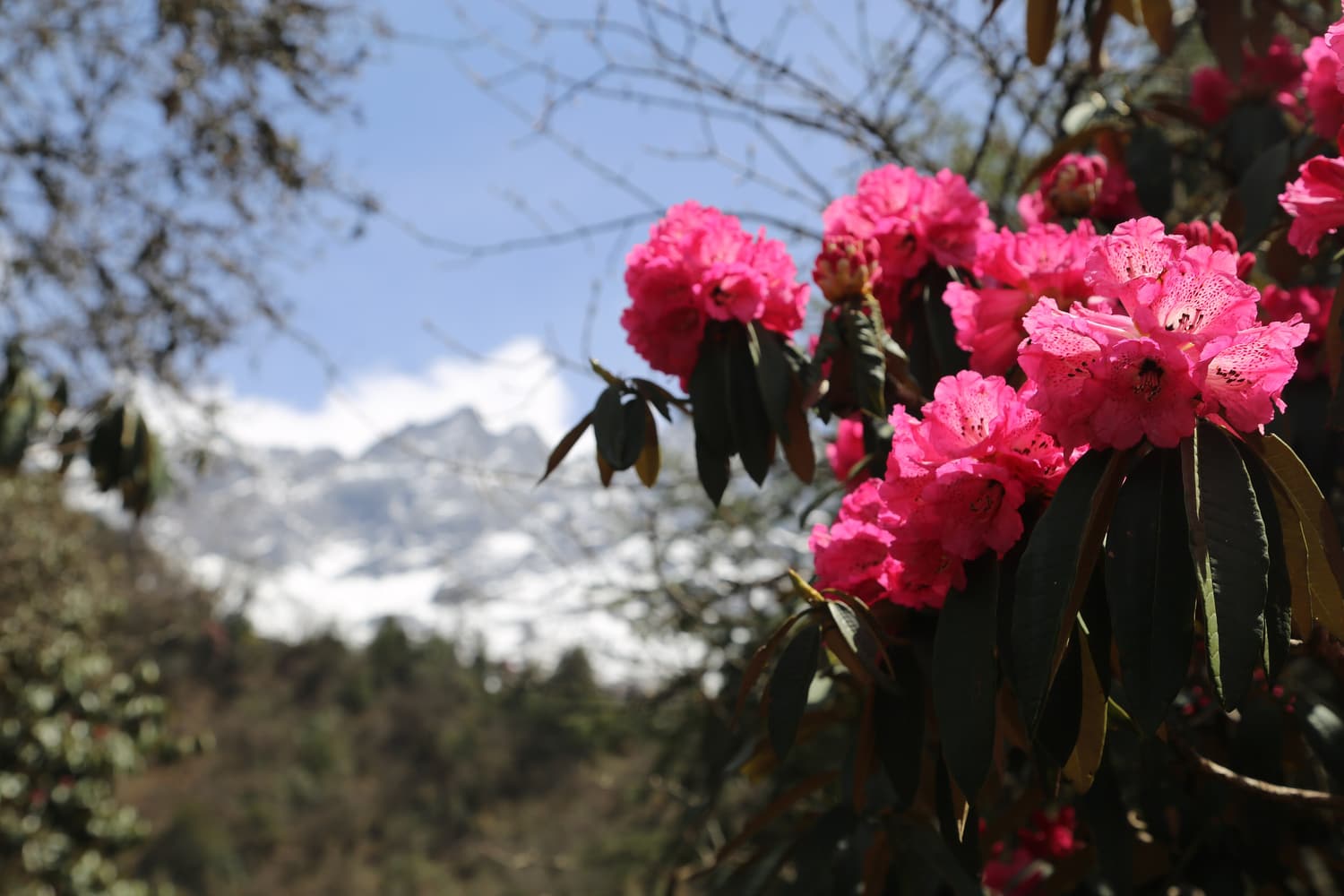
The rhododendron bloom moves uphill through spring: red Rhododendron arboreum, Nepal’s national flower, opens first in the gorge, with pink, white and yellow species following around Namche and Tengboche in late April and May.
Mammals
Sherpa Buddhism discourages the killing of animals, and wildlife in the Khumbu is less shy than in much of the Himalaya. You will not see everything on this list — but you will almost certainly see some of it.
- Himalayan tahr. A shaggy wild goat, the park’s most visible large mammal. Herds graze the steep slopes above Namche, around Syangboche, Phortse and Pangboche, often close to the trail.
- Himalayan musk deer. Small, solitary and long-fanged, hunted elsewhere for its musk gland. Look at dawn and dusk in the birch and rhododendron forest near Tengboche, Deboche and Phortse.
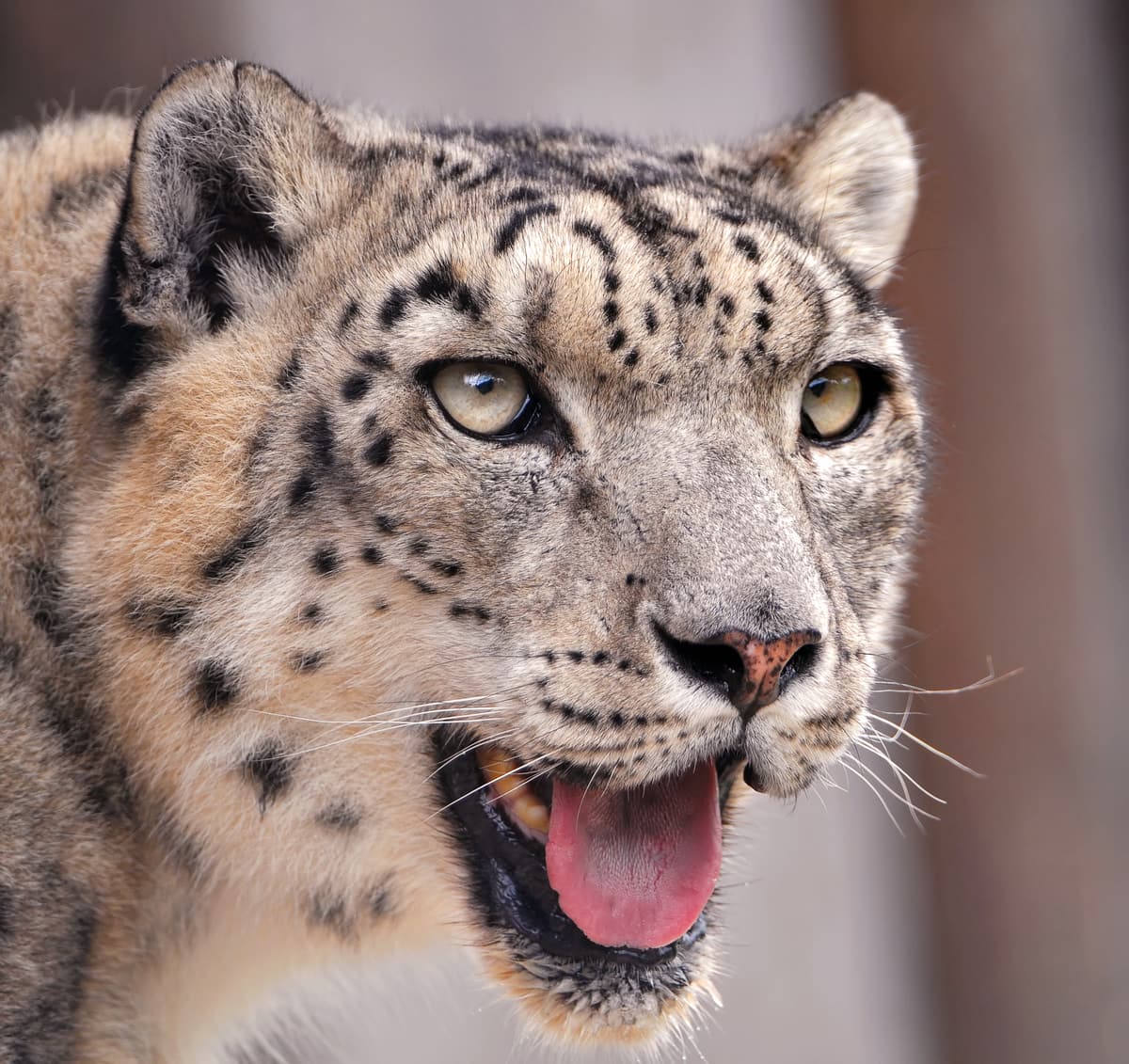
- Snow leopard. After an absence of some decades the cat returned to the park, and camera traps and tracks have confirmed a small resident population that preys mainly on tahr. Sightings are extremely rare; the high slopes around Phortse and the Gokyo valley are where researchers find most signs.
- Red panda. Recorded in the bamboo and fir forests of the lower park and buffer zone. It is nocturnal, lives in trees and is almost never seen by trekkers.
- Others. Himalayan serow and goral on forested cliffs, Himalayan black bear and grey langur lower down, wolf, marten, weasel, and the ever-present pika — a small, tailless relative of the rabbit that darts among the boulders up to 5,000 m.
- Yaks. Not wild: the animals on the trail are domestic yaks, cattle–yak hybrids called dzopkyo (male) and dzum (female), and mules lower down.
Birds
More than a hundred bird species have been recorded in the park.
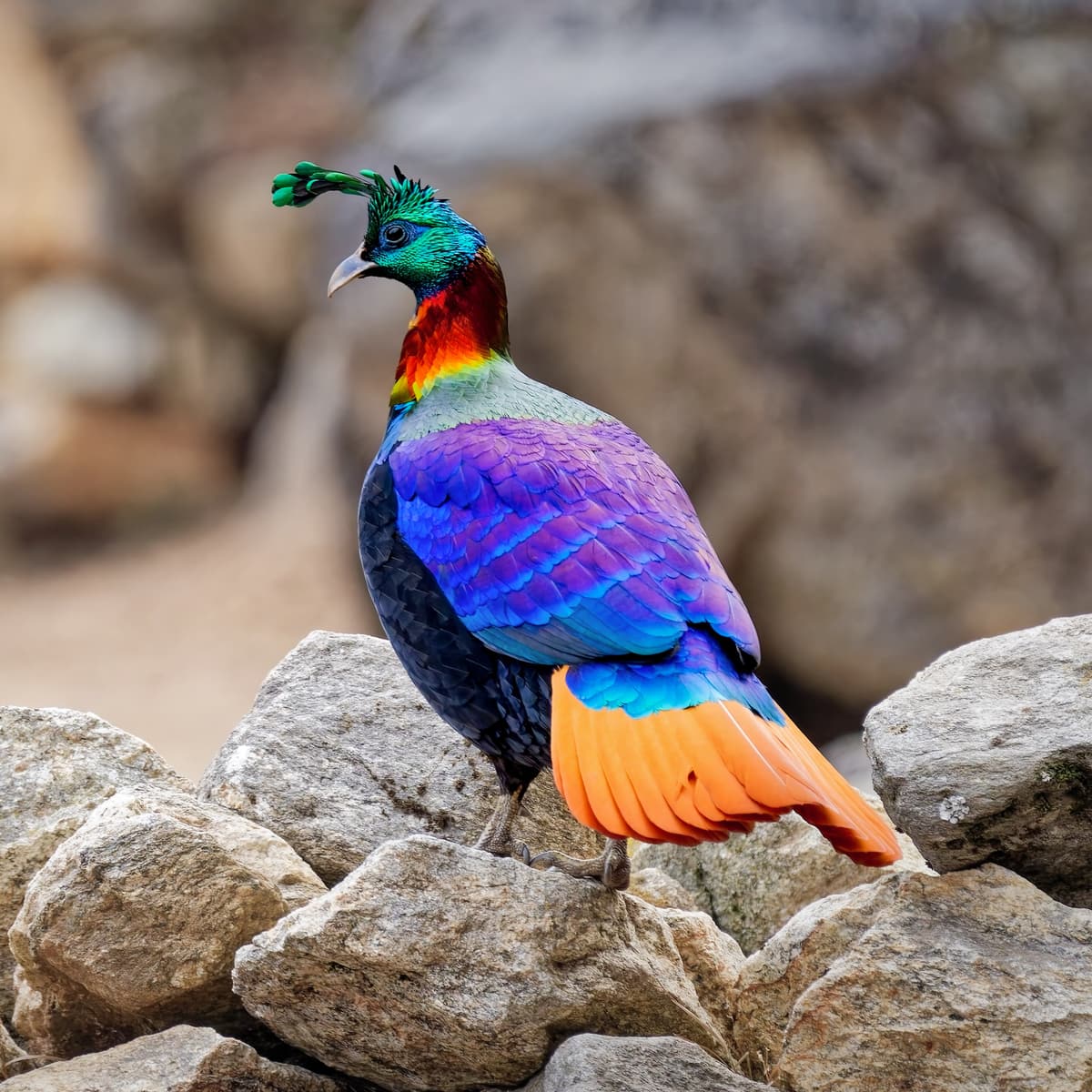
- Himalayan monal (danphe). Nepal’s national bird. The male is iridescent green, copper and blue with a white rump; listen for its whistle on the slopes above Namche and around Tengboche.
- Blood pheasant and Tibetan snowcock, often in small parties near the trail.
- Red-billed and yellow-billed choughs, acrobatic crows that follow climbers to extreme altitude.
- Lammergeier (bearded vulture) and Himalayan griffon, soaring along the valley walls on wingspans approaching three metres.
- Waterfowl on the Gokyo Lakes, including ruddy shelduck and migrating ducks in spring and autumn.
Watching wildlife well
- Walk early, quietly and in small groups; carry binoculars.
- The Namche–Syangboche–Khumjung slopes, the Tengboche forest and the Phortse trail are the most productive areas.
- Never feed animals or approach for a photograph.
- Ask your guide — many know exactly where the tahr and monal were yesterday.