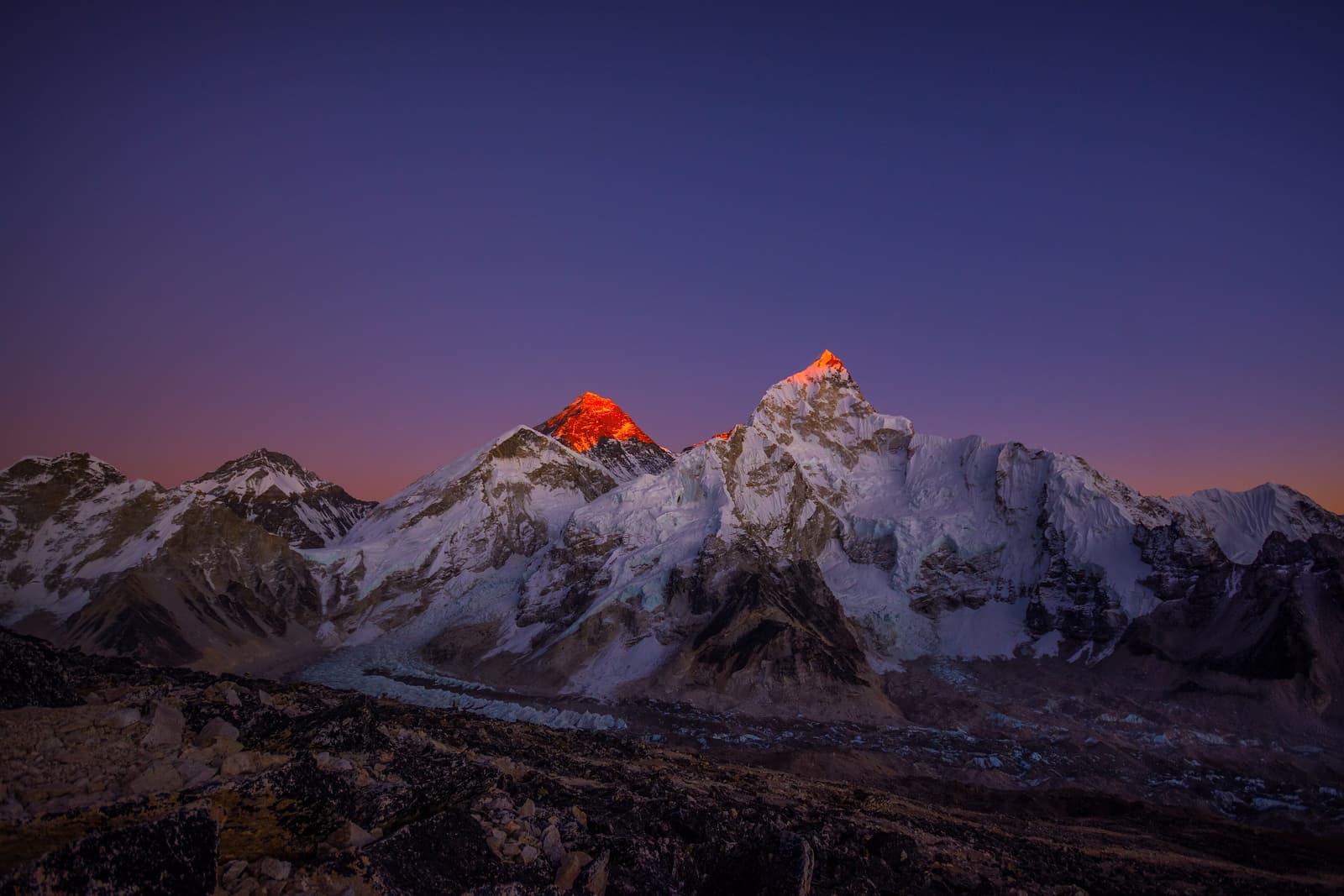
Every route in the park starts the same way — Lukla, the Dudh Koshi, the gate at Monjo and the climb to Namche Bazaar — and then the valleys divide. Which one you follow should depend on how much time you have, how you cope with altitude and whether you came for mountains, for culture or for both.
The table gives typical figures for a round trip from Lukla at a sensible pace. Add at least two days for flights and weather.
| Route | Days from Lukla | Highest point | Difficulty | Best for |
|---|---|---|---|---|
| Namche & Everest View | 3–5 | 3,880 m | Moderate | A first sight of Everest, Sherpa villages |
| Everest panorama to Tengboche | 6–8 | 3,867 m | Moderate | Monastery, forests, big views without extreme altitude |
| Thame valley | 5–7 | 3,800 m | Moderate | Quiet trails, gompa, mountaineering history |
| Ama Dablam Base Camp | 7–9 | 4,600 m | Moderate–hard | A real objective in about a week |
| Gokyo Lakes & Gokyo Ri | 10–12 | 5,357 m | Hard | Lakes, glacier, the best panorama |
| Everest Base Camp & Kala Patthar | 12–14 | 5,644 m | Hard | The classic |
| Base Camp + Gokyo via Cho La | 15–18 | 5,644 m | Very hard | Two valleys without retracing |
| Three Passes | 18–21 | 5,644 m | Very hard | The whole park |
Short treks: three to five days
The shortest worthwhile visit flies to Lukla, walks to Namche Bazaar in two days, spends a day on the shelf above it — Hotel Everest View, Khumjung and Khunde — and walks out in a day and a half. You see Everest, Lhotse and Ama Dablam, visit the Hillary school and a village gompa, and never sleep above about 3,450 m.
- Day 1: fly to Lukla (2,860 m), walk to Phakding or Monjo.
- Day 2: enter the park, climb to Namche Bazaar (3,440 m).
- Day 3: Everest View ridge, Khumjung and Khunde loop; second night in Namche.
- Day 4: descend to Phakding or Lukla.
- Day 5: fly out (keep a spare day for weather).
With one or two more days, add an overnight in Thame or continue to Tengboche.
Tengboche and the “Everest panorama”
A week allows you to walk on from Namche to Tengboche Monastery, on its forested saddle beneath Ama Dablam, and return via Khumjung. It is the best choice for travellers interested in Sherpa religion and forests — and the one to pick if you can time it for Mani Rimdu.
Ama Dablam Base Camp
From Tengboche it is two hours to Pangboche, and from there a day walk leads to the grassy base camp of Ama Dablam at about 4,600 m. As a goal it is higher and wilder than the viewpoints yet needs only eight or nine days, which makes it the natural “next step” after an Everest View trek.
Gokyo Lakes and Gokyo Ri
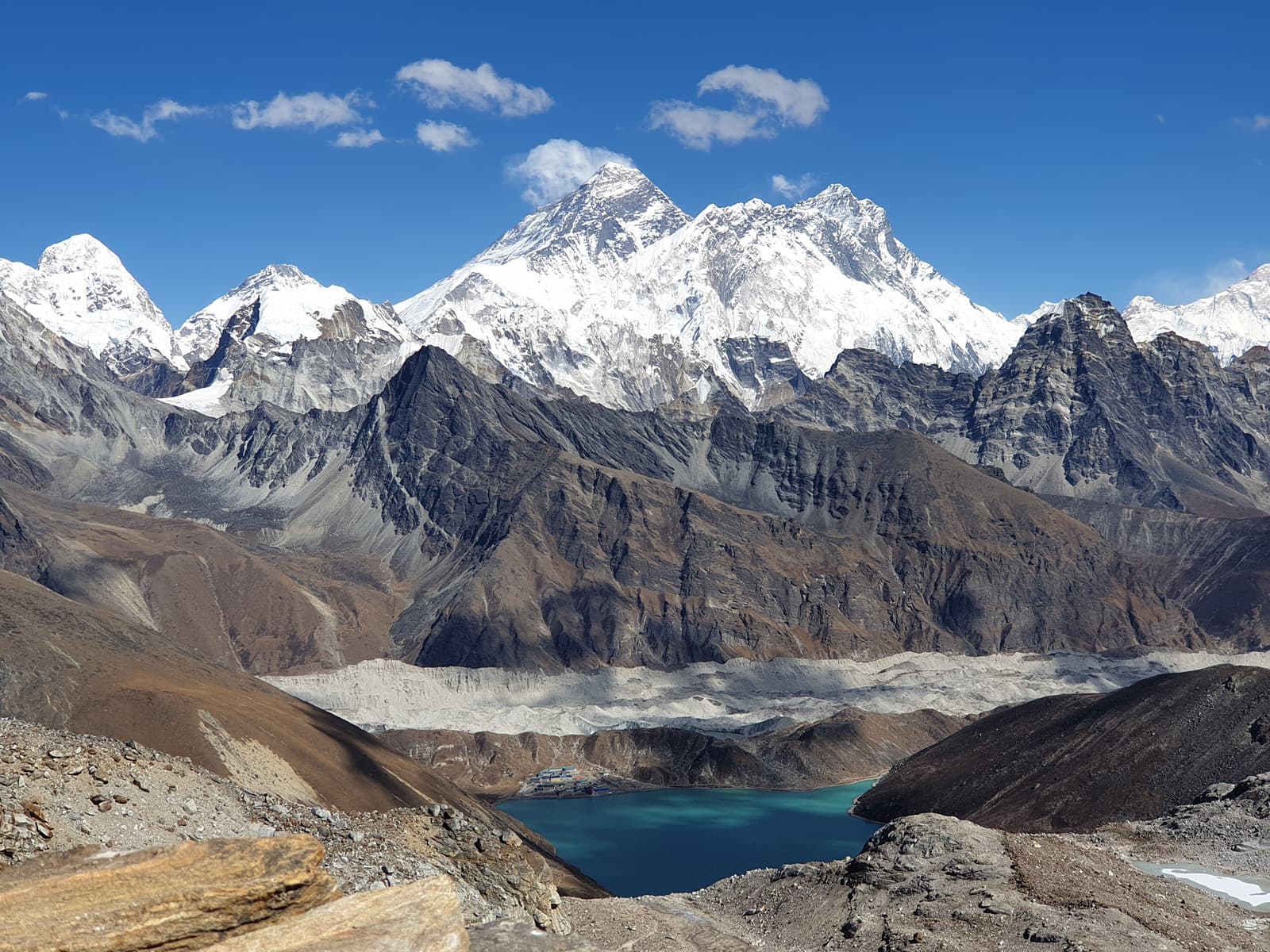
The Gokyo valley leaves the main trail above Namche and climbs beside the Dudh Koshi to a chain of turquoise lakes at the edge of the Ngozumpa Glacier. The trail is quieter, the lodges are good, and Gokyo Ri (5,357 m) looks out over Cho Oyu, Everest, Lhotse and Makalu. The valley gains height fast: plan nights at Dole and Machhermo and allow 10–12 days.
Everest Base Camp and Kala Patthar
The park’s classic route continues from Pangboche through Dingboche or Pheriche to Lobuche and Gorak Shep, for Base Camp and Kala Patthar. It needs 12–14 days and two acclimatisation stops. If this is your priority, choose an itinerary with rest days at Namche and Dingboche and compare the options on our tours page.
The Three Passes
The Three Passes circuit joins all of the above by crossing Kongma La (5,535 m), Cho La (5,420 m) and Renjo La (5,360 m). It is the finest long trek in the Khumbu and the hardest: 18–21 days, repeated nights above 4,700 m and passes that can be closed by snow. A single pass makes a good compromise — Cho La to link Base Camp with Gokyo, or Renjo La to walk out from Gokyo through Thame.
Trekking peaks: Island Peak and Mera Peak
Island Peak (Imja Tse, 6,189 m) rises at the head of the Imja valley above Chhukung. It is the most popular climbing peak in the park: a pre-dawn start, a glacier, and a steep headwall on fixed ropes. It requires a climbing permit, a climbing guide and basic skills with crampons, ice axe and jumar, which operators usually teach at base camp. Mera Peak (6,476 m), reached from Lukla by a separate valley to the east, lies outside the national park in the neighbouring Makalu Barun area; it is higher but less steep.
Helicopter tours
A helicopter day tour leaves Kathmandu at dawn, refuels at Lukla and flies up the Khumbu over Namche, Tengboche and the glacier, usually with a brief landing near Kala Patthar and a breakfast stop at Hotel Everest View. The whole outing takes four to six hours. It is expensive — and unforgettable — and it suits visitors without the time or the health for a trek. Everything depends on the weather; flights go early and may be postponed. Shared “group-joining” seats reduce the price.
Mountain flights
The one-hour mountain flight from Kathmandu is the simplest way to see Sagarmatha’s summits. Small airliners fly east along the range at dawn so that each passenger has a window, pass within sight of Everest, Lhotse and Cho Oyu, and return. It does not land in the park. Flights run in the clearer months and are cancelled or refunded in poor visibility.
How to choose
- Limited time or first time at altitude: Namche and the Everest View ridge, or Tengboche.
- Want a summit view without the Base Camp crowds: Gokyo.
- Want to say you stood at Base Camp: the classic route — but give it 12 days or more.
- Experienced and fit, with three weeks: the Three Passes.
- No trekking at all: a mountain flight or helicopter tour.